My Manager Called Me In at 7 A.M. and Handed Me Something That Couple Left Behind
A well-dressed couple walked out of the restaurant without paying their $430 bill, and my manager ordered me to cover it. Early the following morning, he called me back to the restaurant and handed me something they had left behind.
“You’re going to want to see this,” he said.
It’s strange how $430 can represent nothing more than one evening meal to certain people, while to others, it can determine whether their family pays rent or buys groceries.
At twenty-two, I was still attending college and helping support my family. My job at an upscale restaurant called The Briar Room in Westbridge was what kept us financially afloat.
The income could be good, especially on busy evenings, but the customers were unpredictable.
Some guests treated the staff with warmth and respect.
Others behaved as though servers were completely invisible.
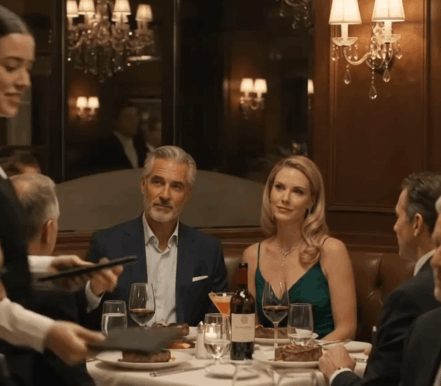
On Thursday evening, I was assigned to a fashionable couple who ordered without glancing at the prices.
They selected two premium steaks, several appetizers, cocktails, dessert, and one of the most expensive bottles of wine on the menu.
When their meal ended, the total came to a little over $430.
The man requested the check, so I placed it inside a leather tray and left to assist another table.
I returned approximately eight minutes later.
The booth was vacant.
The check tray was gone as well.
The couple had disappeared, leaving me responsible for an unpaid $430 bill.
I immediately reported the situation to my manager, Marcus.
He didn’t check the security footage, call the police, or ask anyone whether they had seen the couple leave.
Instead, he looked at the empty booth and shrugged.
“They were your customers,” he said. “That means the missing payment is your responsibility.”
My heart sank.
That money wasn’t disposable income. My family depended on every dollar I earned.
I went home that night wondering how I would explain that nearly an entire week’s wages had vanished because two strangers had decided not to pay.
At 7:15 on Friday morning, my phone rang.
It was Marcus.
His voice sounded unusually tense as he told me to come to the restaurant immediately.
While the cleaning crew was working after closing, one of them had found something wedged deep beneath the couple’s booth.
It wasn’t their wallet.
It wasn’t cash.
And it wasn’t the missing check tray.
When I entered the restaurant, Marcus was already waiting near the front desk.
His face looked pale, and the confidence he had shown the previous evening was gone.
He approached me slowly, holding an unfamiliar object in both hands.
Before I could ask what had happened, he spoke in a low voice.
“I think you need to see this.”
What Marcus Was Holding
It was a phone.
A cracked-screen Android in a slim black case, the kind that could belong to anyone. But it was unlocked. And Marcus had already looked at what was open on the screen.
He turned it toward me without a word.
The browser was open to a review page. Yelp. The Briar Room. And someone had started typing a review but never submitted it. The timestamp in the draft showed 9:47 p.m., which was right around the time I’d gone to check on table six and found booth four empty.
The draft read: Server was attentive, food was outstanding, wine selection impeccable. We will absolutely return. Left cash in the tray – full amount plus tip. Hope it reaches the right hands.
I read it twice.
Marcus watched my face.
“The tray,” I said.
He nodded toward the host stand. The leather check tray was sitting there, closed. He’d found it tucked behind the stand’s lower shelf, underneath a stack of menus. The cleaning crew hadn’t found the phone under the booth until after Marcus had already locked up, so he’d called them back in, and that’s when they found this too.
He opened the tray.
Inside: five crisp hundred-dollar bills, folded once. And a handwritten note on the back of a receipt from a pharmacy two blocks over.
Sorry for any confusion. We paid in cash and left quickly – my wife wasn’t feeling well. Please make sure your server gets the full tip. She was wonderful.
$500 total. Sixty-eight dollars more than the bill.
I stood there holding the tray and didn’t say anything for a few seconds.
Marcus cleared his throat. “I owe you an apology.”
The Part He Didn’t Say Out Loud
He handed me the cash and the note. All of it. He didn’t take a cut, didn’t mention the house policy about cash payments needing to go through the register first, didn’t do any of the things I half-expected him to do.
But here’s what he also didn’t say: that he’d been wrong to make me responsible in the first place.
He didn’t say that making a server cover a dine-and-dash out of their own wages was illegal in most states. He didn’t say he should have checked the cameras before shrugging at me. He didn’t say sorry for the eight hours I’d spent doing the math in my head, figuring out which bill I could push back, whether my mom would understand, whether I could pick up a Saturday shift somewhere else.
He just said “I owe you an apology” and handed me the money like that closed the account.
I said thank you. I took the cash. I pocketed my sixty-eight dollar tip.
And I drove home thinking about what had actually happened.
The Couple I Never Properly Met
I’d waited on dozens of tables like theirs. Couples who came in dressed like the prices were irrelevant, who ordered confidently and spoke to each other in low voices and rarely made eye contact with me beyond the initial order.
I hadn’t thought much of them at the time. The woman had seemed distracted toward the end of the meal, quieter than she’d been earlier. The man had asked for the check quickly, not rudely, just efficiently. I’d assumed they were in a hurry.
Turns out she’d gotten sick. Not dramatically, just the kind of sick where you need to get outside fast and you’re not thinking about whether the server is going to catch hell for your quick exit. They’d left cash. They’d left a note. He’d even started a Yelp review from the parking lot, apparently, before they drove to the pharmacy.
The phone must have slipped out in the booth when he pulled out his wallet. Slim case, dark upholstery. Easy to miss.
What I kept coming back to was the note. He didn’t have to write it. He could have just left the cash. But he’d taken the time to explain, to make sure I got the tip specifically, to apologize for the confusion.
Two strangers who didn’t know my name, who would probably never come back, who had no reason to think about me at all once they left.
They thought about me anyway.
What I Did with the Phone
I left it with Marcus and told him to turn it in to the local non-emergency police line as lost property. Standard protocol. If the owner called the restaurant, Marcus had the number.
Three days later, a man called asking about it. Marcus took the call. I wasn’t there, but Marcus told me about it the next time I came in for a shift.
The man’s name was Gerald. He’d called the restaurant specifically because his wife remembered the name of the place and figured it was worth a shot. Marcus told him the phone was at the second district station on Alderman Street. Gerald thanked him and asked Marcus to pass along his thanks to the server who’d been working their table.
Marcus did pass it along, to his credit.
“He said you made the evening special for them,” Marcus told me. “Said his wife hadn’t been out for a nice dinner in a while and it meant a lot.”
I didn’t ask why she hadn’t been out in a while. That felt like something that wasn’t mine to know.
But I thought about the pharmacy receipt the note was written on. The timestamp on the Yelp draft at 9:47, him sitting in the car while she was sick, still taking a minute to type out something kind about the place they’d just left.
Some details just sit with you and you can’t explain why.
What Changed After That Night
Not everything. Most things stayed exactly the same.
I still worked doubles on weekends. I still helped cover my family’s utilities. Marcus still managed the floor the way Marcus managed the floor, which meant he was competent and fair about sixty percent of the time and the other forty percent you just had to absorb.
But something shifted in how I thought about the job.
Before that Thursday, I’d started to develop the specific numbness that comes from doing service work long enough. You stop seeing tables as people. They become orders, problems, tip percentages. You protect yourself by caring less.
Gerald and his wife cracked that a little.
Not in a sentimental way. Not in a way that made me want to write something on a napkin. Just in the practical sense that I started paying attention again. To whether someone at a table looked off, whether they needed something they hadn’t asked for, whether the evening was going the way they’d hoped.
It’s a small thing. It doesn’t pay rent.
But it made the job feel less like something I was enduring and more like something I was actually doing.
The Shift I Still Think About
A few weeks later, a woman came in alone and sat at booth four. Same booth.
She ordered a glass of wine and the salmon and spent most of the meal reading something on her tablet. Quiet, no trouble. When she got the check she paid immediately, tipped twenty percent exactly, and left.
Nothing happened.
But I noticed she’d left her reading glasses on the table, so I grabbed them and caught her at the door. She patted her coat pocket, looked relieved, thanked me.
“I’d have driven all the way home before I noticed,” she said.
“Happens to everyone,” I told her.
She left. I went back to the floor.
Sixty-eight dollars and one cracked phone. That’s all it took to remind me that most people, most of the time, are not trying to get away with anything. They’re just moving through their evenings the same way I’m moving through mine, doing their best, occasionally leaving things behind.
Marcus never officially revised the policy about dine-and-dash liability.
I looked it up two days after the incident and found out he’d been wrong about it being my responsibility. Wrong legally, wrong by the restaurant’s own employee handbook. He’d just said it and I’d believed him because he was the manager and I was twenty-two.
I didn’t make a thing of it. But I also never forgot it.
The next time he tried to tell me something that didn’t sound right, I asked him to show me where that was written down.
He didn’t love that.
I didn’t care.
—
If this one stayed with you, pass it on to someone who’s ever worked a job where the math was never in their favor.
