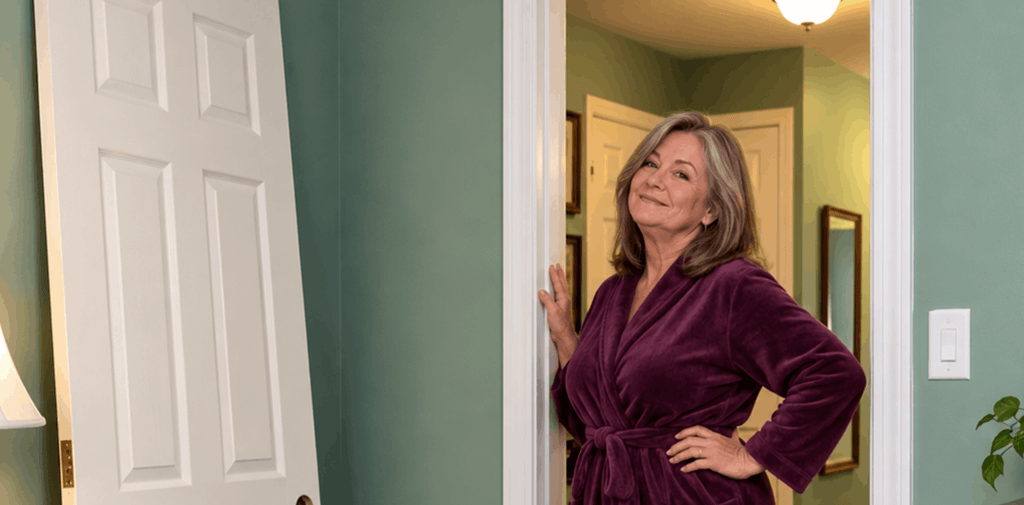
My mother-in-law removed our bedroom door, insisting, “My son doesn’t hide anything from me”
My mother-in-law removed our bedroom door, insisting, “My son doesn’t hide anything from me” – but that evening, Nathan’s response left her screaming and red-faced.
Diane was supposed to stay with us for nine days.
A burst pipe had flooded her condo in Fairmont, so Nathan offered her our spare room until the repairs were finished.
By the third day, I was already counting down to her departure.
She treated boundaries like suggestions and never bothered knocking.
She walked into our bedroom while I was getting dressed because she “needed to borrow a charging cable.” She rummaged through Nathan’s desk looking for envelopes and even lifted my birth control off the bedside table.
When she noticed my expression, she chuckled.
“Don’t act so shocked. He was my son long before he became your husband.”
Nathan told her twice that our bedroom was off-limits.
Diane simply rolled her eyes.
“To visitors, perhaps. I’m his mother.”
Thursday was when things finally went too far.
I came home from work and stopped in the upstairs corridor.
Our bedroom door was gone.
It was propped against the wall, with its hinges and screws carefully arranged on a towel. Inside, Diane was folding Nathan’s laundry.
For a moment, I couldn’t speak.
“What happened here?”
She kept folding.
“You two keep shutting yourselves away like children. It’s silly.”
“You actually removed our door?”
She finally looked up.
“My son doesn’t hide anything from me.”
My face grew warm.
“This is my bedroom, too.”
“And you’re living in my son’s home.”
Nathan and I had bought the place together.
Before I could answer, he arrived home. He loosened his collar, looked toward our room, and stopped.
His eyes moved from the empty doorway to the door against the wall, then to his mother.
“Mom.”
Diane smiled as though she expected him to thank her.
“Isn’t that better? Families shouldn’t put barriers between each other.”
Instead of starting an argument, Nathan quietly guided me down to the kitchen.
“Stay calm,” he murmured. “I’ll handle this.”
I studied his face.
“How?”
A small smile tugged at his mouth.
“You’ll see later tonight.”
Diane retired to the spare room around half past nine.
About fifty minutes later, Nathan slipped into his robe and headed upstairs.
A few moments passed.
Then Diane screamed.
“NATHAN!”
I hurried up the stairs.
She was standing outside the spare room, her cheeks bright red and her expression furious.
Nathan stood nearby, perfectly composed, with a single object in his hand.
The moment I realized what he had done, I had to bite back a laugh.
What Was in His Hand
A screwdriver.
He was holding a screwdriver, and the spare room door, Diane’s door, was propped against the hallway wall. Hinges off. Screws in a neat row on the carpet.
Same towel arrangement, even. He’d copied her method exactly.
“WHAT IS THIS?” She was pointing at the empty doorframe like it had personally insulted her.
Nathan’s voice was completely level. “Families shouldn’t put barriers between each other.”
“That is not the same thing.”
“You’re right. It isn’t.” He set the screwdriver on the little hall table. “Our door comes back up tomorrow morning. Yours goes back up when you’re ready to have a conversation about what you did today.”
Diane turned to me. I don’t know what she expected, sympathy maybe, but I was studying a water stain on the ceiling with intense concentration.
“This is your doing,” she said.
“I was in the kitchen,” I said.
She wasn’t wrong that I’d wanted something done. She was wrong about who’d thought of it.
How Long She’d Been Like This
I should back up, because this wasn’t a burst-pipe personality. This was just Diane.
Nathan’s dad, Ray, had died six years before I met Nathan, and from what I could piece together across four years of marriage and careful listening, Ray had been a quiet man who liked fishing and avoided conflict the way some people avoid gluten. He’d built a life around not engaging. Diane had built a life around filling every room she entered, every silence, every closed door.
Nathan was her only child. She’d raised him alone after Ray’s heart attack, and she was proud of that in a way that sometimes curdled into ownership.
She wasn’t cruel, exactly. She brought food when we were sick. She remembered my birthday without being reminded. She’d cried at our wedding in a way that seemed genuine.
But she also once rearranged our kitchen cabinets while we were at a wedding because she found our system “inefficient.” She’d told Nathan, three months after we married, that I seemed like someone who would “come into her own eventually.” She called our house “Nathan’s place” with a consistency that I’d stopped believing was accidental.
The birth control thing on the bedside table, that one she’d picked up and looked at the label. Set it back down without a word.
I’d told Nathan that night and watched his jaw do something complicated.
“I’ll talk to her,” he said.
He had. Twice. And here we were.
The Part Where She Tried to Negotiate
Diane stood in the doorframe, or where the doorframe used to lead somewhere private, and she tried four different approaches in about six minutes.
First was outrage. The screaming version. Nathan waited it out.
Then came wounded. Her voice dropped and she said she’d only been trying to help with the laundry, she hadn’t meant any harm, she didn’t understand why everything she did was treated like an attack.
Nathan said, “The laundry wasn’t the issue, Mom.”
Then came the appeal to history. She reminded him that she had raised him in a house with no secrets, that they’d always been open with each other, that she didn’t see why marriage should change that.
Nathan said, “It’s not about secrets. It’s about the fact that Claire and I have a bedroom, and you removed the door to it.”
Then she tried me directly. “Claire, surely you understand I wasn’t trying to make you uncomfortable.”
I said, “You picked up my prescription medication and read the label.”
That one sat there for a second.
She pivoted back to Nathan.
What He Said That She Couldn’t Answer
He didn’t raise his voice once. That was the thing. I’d half-expected something to crack in him, because this was his mother and it’s complicated when it’s your mother, but he just stood there in his robe in the upstairs hall looking like a man who had already decided something.
“Here’s what I need you to understand,” he said. “Claire is my wife. This is our house. Both words matter. Our. Not mine with her living in it. Ours.”
Diane opened her mouth.
He kept going. “When you took that door off, you weren’t just telling Claire she doesn’t have privacy. You were telling me that my marriage is less important than your comfort. I don’t think you meant it that way. But that’s what it was.”
Diane’s face had gone from red to something harder to read. Not angry anymore. Something closer to the expression people make when they’re doing math they don’t like the answer to.
“I’m your mother,” she said, but quieter.
“You are,” Nathan said. “And she’s my wife. Those are both true at the same time. They don’t cancel each other out.”
Nobody said anything for a moment.
Down the hall, the spare room gaped open, her suitcase visible on the bed, her reading glasses on the nightstand.
“This feels very dramatic,” Diane said finally.
“The door comes back up tomorrow morning,” Nathan said again. “Yours goes back up when you’re ready.”
He turned and walked back to our room. Which still had no door, so it wasn’t a particularly grand exit, but I followed him and we sat on the edge of the bed in the dark and I put my head on his shoulder and he put his arm around me and we listened to Diane stand in the hall for another two minutes before she went into the spare room and we heard her sit down on the bed.
What She Did at Breakfast
I’d been expecting cold silence. Maybe an early departure. I’d half-packed a bag of contingency apologies in my head, things I could say to smooth it over if Nathan wanted me to, because sometimes that’s what you do.
But Diane came down at seven-fifteen looking like someone who’d made a decision overnight.
She sat at the kitchen table while Nathan made coffee. She didn’t say good morning right away. She looked at her hands.
Then she said, “I owe you both an apology.”
Nathan set a mug in front of her.
“The door was wrong,” she said. “I knew it was wrong when I was doing it. I told myself it wasn’t.” She looked at me. “And the other things. Going through your desk. The – ” she paused. “The other things.”
I said, “Okay.”
She said, “I don’t always know where the line is.”
I said, “I know.”
Nathan sat down across from her. “We can work on that.”
It wasn’t a grand scene. Nobody cried. She didn’t transform into a different person over coffee. But she ate her toast and she asked me about the project I’d mentioned at dinner two days earlier, the one at work, and she listened to the answer.
Both doors went back up that morning. Nathan did his first, then hers. She held the hinges while he drove the screws.
She stayed the remaining five days. She knocked every time.
How It Actually Ended
Diane left on a Tuesday. The pipe in her condo had been fixed and the floors were dry and the restoration company had given her the all-clear.
She hugged Nathan for a long time at the door. Then she turned to me and hugged me too, which wasn’t something she’d done before, not like that.
She said, “You’re good for him.”
I said, “He’s good for himself.”
She smiled. It was the kind of smile that costs something.
Her car backed out of the driveway and Nathan stood next to me on the porch and we watched until she turned at the corner.
“You okay?” he said.
“Yeah,” I said. “You?”
He thought about it. “Yeah. Actually.”
We went back inside. I made us lunch. Nathan rehung the bedroom door all the way, checked that the latch caught clean, and swung it open and closed twice just to hear it work.
Then he left it open, because we wanted to.
If this one hit close to home, pass it along to someone who needs to know they’re not alone in it.
