My Father Told Me the Tattoo Marked Somewhere Safe. The General Knew Something Else.
The laughter of nearly three hundred soldiers died in less than five seconds.
Not because someone shouted.
Not because an alarm sounded.
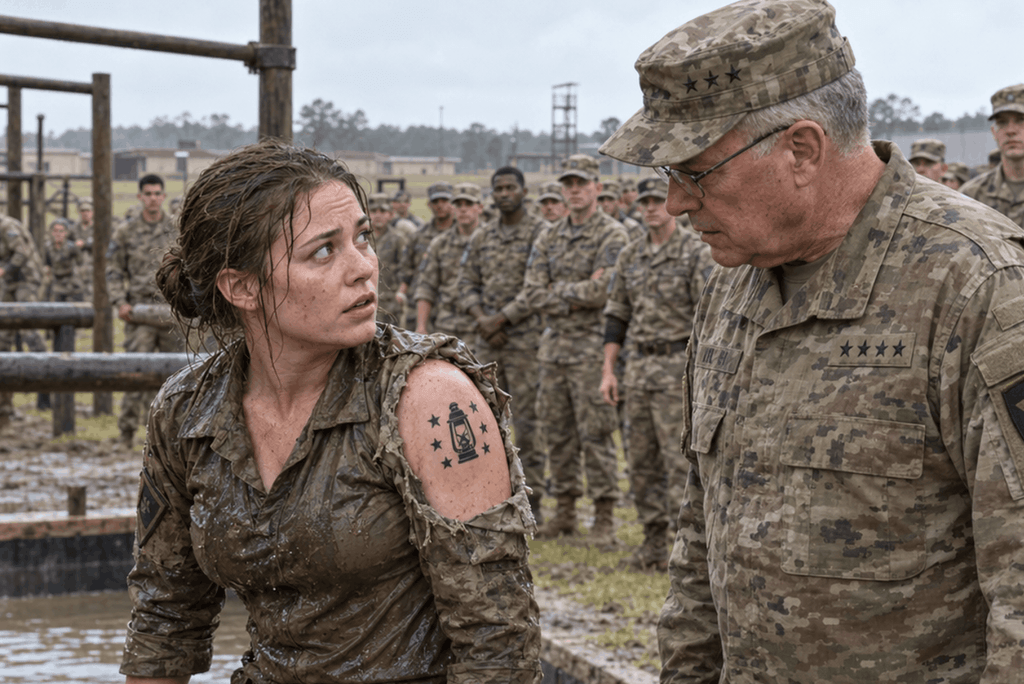
But because a four-star general had just seen the tattoo on Specialist Nora Blake’s shoulder – and suddenly looked as though he had witnessed something that was never supposed to be revealed.
A moment earlier, Nora had been climbing out of the obstacle course’s water pit. Her torn sleeve exposed a small black lantern surrounded by six stars.
Someone joked that she’d mistaken the Army for a motorcycle club.
Then General Harlan stopped beside her.
“Where did you see that symbol?”
Nora straightened.
“In my father’s notebook, sir.”
“His name?”
“Thomas Blake.”
The general’s face drained.
“Get your jacket, Specialist. Come with me.”
Inside the training office, Harlan dismissed his aide but left the door open.
“Is your father alive?”
“Yes, sir.”
“What did he tell you about the lantern?”
“That it marked somewhere safe.”
For years, Dad had drawn it on notes tucked inside her school lunches. When her first deployment orders arrived, he drew it one last time.
She’d had it tattooed before leaving.
“What about the stars?” Harlan asked.
“Six people he brought home.”
The general sat down.
“Did he tell you their names?”
“No.”
Outside, an instructor began calling the next group onto the course.
Harlan removed his glasses.
“Your father was a civilian driver attached to an evacuation team. I was the officer responsible for bringing that team back.”
Nora waited.
“We found his vehicle burned out. We were told everyone inside was dead.”
“Obviously, someone was wrong.”
“Yes,” Harlan said. “Someone was.”
He asked whether she would call her father.
Dad answered on the second ring.
“You all right, sweetheart?”
“I’m fine. Someone here knows you.”
She handed over the phone.
“Tom. It’s William Harlan.”
For several seconds, Nora heard nothing.
Then her father spoke so loudly she could hear him from across the desk.
“Where’s my daughter?”
“Right beside me.”
“Put her back on.”
Harlan returned the phone immediately.
“Nora, listen carefully. You haven’t done anything wrong.”
“Dad, what happened?”
“Is your name on that tattoo?”
She touched her shoulder.
“No.”
“All right.”
“Why would my name – “
“Ask him who gave the order to stop searching.”
Nora looked at the general.
He had heard.
Harlan opened his briefcase and took out a creased photograph.
Six children stood beside a battered truck.
One was a small girl clutching a black lantern.
On her wrist was the silver bracelet Nora kept in her bedside drawer.
“My father said that belonged to my mother.”
Harlan looked at the phone.
“Tom,” he said, “you told her she was yours?”
Her father’s breathing filled the silence.
Then he said, “Tell her what would have happened if I’d told the truth.”
What Harlan Remembered the Night the Vehicle Burned
Harlan set the photograph on the desk between them.
He didn’t look at Nora. He looked at the phone.
“Tom. You’re asking me to tell your daughter something you’ve had twenty-three years to say yourself.”
Her father said nothing.
“I’ll start. You finish.”
He picked up the photograph. Held it so Nora could see.
The girl in the front left – the one clutching the lantern – was maybe three years old. Small enough that the lantern looked oversized in her arms. Her wrist was thin. The bracelet on it was silver, braided, two small charms Nora couldn’t make out in the photograph but knew by feel from holding it every year on what she’d always been told was her mother’s birthday.
March 12th.
A date she’d been given all her life.
“That photograph was taken the night before your father’s convoy departed,” Harlan said. “He was transporting six children to the processing camp outside the city. From there they’d have been transferred to an agency. Placed.”
“What city?”
He told her. A border town she knew from briefings, not from memory.
“Why were children in the convoy at all?”
“He wasn’t supposed to have them. He found them at a checkpoint. Two were injured. He put them in his truck.”
She looked at the phone. Her father still hadn’t spoken.
“What happened to the other five?”
“They made it through the agency. Different families. Different countries.” Harlan paused. “I tracked three of them down years later. They didn’t know about each other.”
“And the girl with the lantern.”
Harlan put the photograph down. “Your father didn’t bring her to the agency. When his truck was found burned at kilometer forty-one, we assumed everyone in it was dead. We didn’t find a body for the girl because your father hadn’t told us she was there.”
He let that sit.
“He’d already taken her across the secondary checkpoint the night before. Separately. Under his own name.”
Outside, the instructor had finished calling the next group. She could hear boots on gravel, the distant bark of a cadence, ordinary sounds from a world that had been ordinary forty minutes ago.
“So he hid me,” Nora said.
“He hid you. And then he staged just enough of the rest to make the search team write it off.”
The Name on the Order
“Who gave the order to stop searching?”
Harlan didn’t answer immediately.
He took off his glasses, cleaned them with the corner of his sleeve. A stall.
“A colonel named Reeves,” he said. “Dennis Reeves. He was the logistics officer for that sector.”
Nora didn’t recognize the name.
“Is he still alive?”
“Retired. Maryland.”
“Why did he want the search stopped?”
Harlan put his glasses back on. “Because he was the one who arranged for the convoy to be hit.”
She kept her face still.
“He had a working relationship with a local commander. The commander wanted those six children. Not to harm them – to use them. Their families had been connected to opposition networks. Children were the currency. Something to bargain with, something to threaten.”
Nobody touched that word.
“Your father found out,” Harlan continued. “Not before the convoy – after he got you across. Someone warned him. He burned the truck himself, Nora. Set it on fire at kilometer forty-one, walked eight kilometers to the secondary post, and asked to be put on a transport home. He filed nothing. He told no one. He just went quiet.”
She thought about her father. The man who’d coached her soccer team and made terrible pancakes every Sunday and driven four hours in a snowstorm to move her into her first apartment. Who had drawn a small black lantern on her lunch notes since she was old enough to read.
Who had a scar on his left forearm he said came from a car accident in 1999.
“The fire,” she said.
Harlan nodded.
What the Bracelet Was For
Her father finally spoke.
“Nora.”
“I’m here.”
“The bracelet was your mother’s. Her name was Darya. She was twenty-six years old when she died. They found the bracelet on her.”
She held the phone closer.
“How did you get it?”
“She gave it to me. She was at the checkpoint. She’d walked three days with the six of you – you were the youngest, you were hers. She handed you to me and she said take her first because she’s the smallest and then come back.”
He stopped.
“I went back,” he said. “She was gone. Someone at the checkpoint had the bracelet. I don’t know how it got there. I bought it from him for forty dollars and put it around your wrist.”
Nora sat down.
She hadn’t realized she’d been standing.
“Your real name,” her father said, “is Nora. She named you Nora. I didn’t change it.”
“But the last name.”
“Blake is mine. I gave you mine.”
Outside someone was laughing. A different group, earlier in the course, not yet tired enough to stop.
“Did you adopt me legally?”
“Yes. It took eighteen months and I’m not going to describe those eighteen months to you right now.”
She almost laughed. She didn’t.
“The lantern,” she said.
“She drew it on the back of your hand with a marker before she handed you to me,” her father said. “She told me it meant you’d find your way home. I don’t know if that’s what it actually means. I don’t speak the language. That’s what she told me.”
Why Your Real Name Can’t Surface
Nora set the phone on the desk without hanging up.
She looked at Harlan.
“Reeves knew there was a girl.”
“He knew there were six children. He knew five went through the agency. When the truck burned, he assumed the sixth died with the driver. He closed the file.”
“But if he finds out the driver’s daughter is in the Army.”
“He’d want to know your real name,” Harlan said. “Not Blake. Your mother’s family name. If you’re who I think you are – and that bracelet says you are – your grandfather was Konstantin Varga. He ran the opposition network out of three cities. He’s been dead fifteen years, but the people who worked with him are not all dead, and neither are the people who worked against him.”
She looked at her shoulder.
The small black lantern. Six stars.
“That’s why Dad asked about the name.”
“Someone with Varga’s granddaughter on a U.S. Army roster,” Harlan said, “would have something worth selling.”
“To who?”
He looked at her like the question answered itself.
What He Needed Her to Understand
She picked the phone back up.
“Dad.”
“Still here.”
“Why didn’t you tell me when I enlisted?”
He was quiet for a moment. “Because I didn’t think it still mattered.”
“But now?”
“Now I’m sitting in my kitchen wishing I’d said something before you got the tattoo.”
“You drew the lantern on my lunches for fifteen years.”
“I know.”
“You drew it on my deployment papers.”
“I know, Nora.”
“You basically tattooed it on me.”
“I didn’t tattoo anything on you, you did that yourself, you were twenty-two – “
“Dad.”
He stopped.
“You kept that symbol on me my whole life. Why?”
Real silence. Not phone lag.
Then: “Because I promised her.”
She put her hand over her chest pocket where she’d folded the photograph. The slight stiffness of it through the fabric.
Six children. Five through the agency.
One he kept.
Harlan had been watching her. He slid the photograph across the desk.
“Keep it,” he said.
She looked at the small girl in the front left. Three years old, maybe. Holding a lantern too big for her. Silver bracelet on her thin wrist. Face tilted slightly away from the camera, like she’d heard something.
Nora had a habit of doing that. Turning toward sounds before anyone else did. Her father had teased her about it since she was small.
She’d assumed it was just a thing she did.
Harlan folded his hands on the desk.
“Your father saved those children without authorization, without support, and without telling anyone, including me. What he did at kilometer forty-one – that was never in any report. I didn’t know it until six years later when I started looking into Reeves.”
“What happened to Reeves?”
“He retired with a pension. Lives on a lake in Maryland.”
She absorbed that.
“I’m telling you this,” Harlan said, “so you understand why your father’s been careful. Not because he was ashamed of you. Not because he was hiding you. Because he was protecting a name you didn’t know was yours.”
She looked at the photograph one more time. Then she folded it and put it in her chest pocket.
She picked up the phone.
“Dad.”
“Still here.”
“The bracelet. March twelfth. Was that her birthday?”
A pause just long enough.
“That was the day I got you to the checkpoint,” he said. “I didn’t know her birthday. I’m sorry. I gave you a day I could remember.”
She hadn’t cried yet. She wasn’t going to cry in a training office in front of a four-star general.
“Okay,” she said.
“Nora.”
“I know, Dad.”
“I would do it again. Every single part of it.”
“I know.”
“You’re mine.”
Outside, boots on gravel. Someone running the course who didn’t know anything had changed.
“I know,” she said again.
She stood, straightened her jacket, and looked at Harlan.
He nodded once. The kind of nod that stays in a room.
She handed him the phone.
He raised it to his ear. Listened for a moment. Then his face did something she didn’t have a word for – like a man watching a ship come back that he’d filed as lost twenty years ago.
“Yeah,” he said. “She is.”
—
If this one got to you, pass it along to someone who’d understand why.