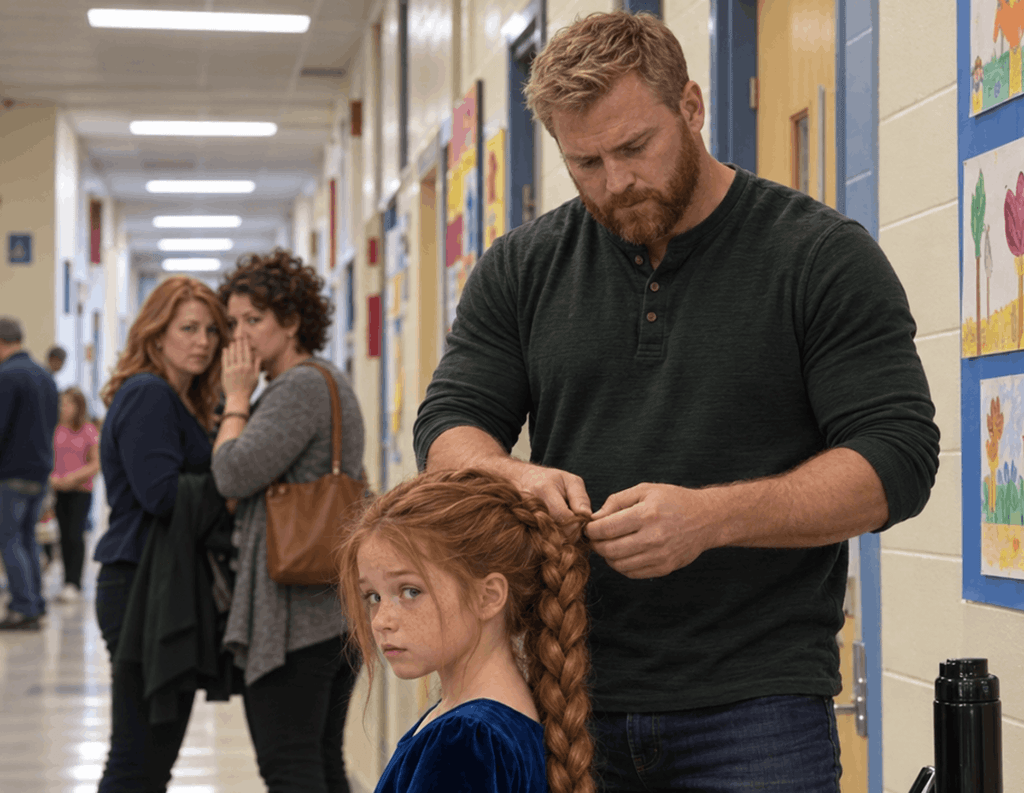
My Daughter’s Classmate Has Hair Down to Her Knees – Her Father’s Reason Silenced Every Parent in That Hallway
Anyone could see that the young girl whose hair fell below her knees struggled with it every day. Still, nobody understood why her father insisted on keeping it so long – until she revealed at the school concert, “I asked Dad to cut it, but he says we must wait until I’m sixteen.”
My daughter attends Maple Ridge Academy in Fairview with a girl named Annabelle, who is famous throughout the school for her remarkably long hair.
Annabelle’s father is always among the first parents to arrive at school functions.
He usually comes directly from work, retrieves a folding mirror and a small case of hair supplies from his car, and finds a quiet place in the hallway.
Then he carefully styles Annabelle’s hair himself.
He creates elaborate French braids, threads colorful ribbons through them, and holds everything securely with dozens of small pins. Even after several hours, not one strand appears out of place.
Many parents find the sight touching.
They often comment that few fathers could braid a child’s hair with such patience and skill.
However, something else always bothered me.
Annabelle’s appearance wasn’t the problem. Her hair was undeniably beautiful.
The problem was how difficult it made her daily life.
Her braid caught on the backs of chairs. During physical education, she had to hold it against her body while running. At lunch, I had watched her wrap it around one arm just to keep it away from her food.
She was only ten years old.
As another mother, I couldn’t help wondering why her father allowed it to become such a burden.
On Thursday evening, before the autumn concert began, the familiar routine unfolded again.
Her father stood near a hallway window and spent nearly thirty-five minutes arranging the enormous braid. When he finished, Annabelle hurried away to join her classmates.
That was when one particularly outspoken mother approached him.
“Someone should have taken that poor girl to a professional hairdresser a long time ago,” she announced.
Annabelle’s father calmly placed the remaining pins inside his case.
“Thank you for your concern,” he replied. “We’re managing.”
“That isn’t the issue,” the woman continued. “Look at what she has to carry around every day. That braid is practically another schoolbag.”
A second mother joined in.
“Anyone can see that she’s uncomfortable. At some point, this stops being dedication and becomes something else.”
Then a third woman spoke. Her voice was quieter, but every word carried through the hallway.
“Perhaps you’re holding on to something you can’t release – and your daughter is the one suffering because of it.”
Annabelle’s father straightened, his expression suddenly tense.
That was when we realized Annabelle had returned.
She was standing directly behind us.
She stepped between the women and her father.
“Don’t speak to my dad that way,” she said firmly.
Then her voice softened.
“He cries whenever he brushes my hair. I’ve asked him to cut it, but he says we have to wait until I turn sixteen.”
For the first time that evening, her father’s careful composure broke.
What Nobody in That Hallway Knew to Ask
He didn’t cry then. Not right there in front of us.
But his face did something. The jaw, the eyes. Like a man who has learned to hold a particular thing very still and just had it jostled.
He put his hand on Annabelle’s shoulder. She leaned into it slightly, the way kids do when they’re not thinking about it.
None of us said anything.
The third woman, the one with the quiet voice who’d said the sharpest thing, took half a step back. She looked at the floor. I don’t blame her for what she said. I’d thought the same thing, just never out loud in a school hallway.
Annabelle’s father looked at all of us for a moment. Not unkindly. More like a man deciding whether a conversation is worth having.
He decided it was.
“Her mother had hair like this,” he said. “Same color. Same weight to it. When Annabelle was born, the nurses commented on it.”
He paused.
“My wife passed away two years ago. March. Annabelle was eight.”
The Sixteen Thing
Nobody asked about the sixteen part right away. We were all still absorbing the first thing.
But Annabelle answered it anyway, like she’d explained it before and didn’t mind explaining it again.
“Mom told me once that she cut her hair when she was sixteen because she wanted to donate it. She said it was the best thing she ever did.” Annabelle touched the end of her braid. “She said it felt like giving someone a piece of yourself.”
Her father cleared his throat.
“Claire made Annabelle promise to do the same thing someday. Annabelle was six when they had that conversation. She doesn’t remember all of it.” He glanced down at his daughter. “But she remembers that part.”
“I do,” Annabelle said. “Mom said when you give something away that took a long time to grow, it means more.”
Six years of growing. Six years of brushing and braiding and ribbons and pins. Six years of catching on chair backs and running with one hand pressed to her side.
The donation would go to a program that makes wigs for children undergoing cancer treatment. Claire had researched it, apparently. Had the organization’s name written on a piece of paper that Annabelle’s father still kept in the small case with the pins.
The outspoken mother, the first one, pressed her fingers to her mouth.
Thirty-Five Minutes Every Single Time
I kept thinking about those thirty-five minutes.
Every school function. Every concert and science fair and awards assembly. He comes from work, gets the case from his car, finds a window with good light.
Thirty-five minutes.
I asked him, later, when the crowd had thinned and we were waiting for the kids to file into the auditorium, how long he’d been doing it.
“Since she was eight and a half,” he said. “After Claire died, I watched about forty videos. Maybe fifty.” A short sound that wasn’t quite a laugh. “I was terrible at first. Annabelle was very patient with me.”
Annabelle, who was nearby, said “You pulled it too tight” without looking up from her program.
“I pulled it too tight,” he confirmed.
He’d gotten better. Anyone could see that. The French braids he produced were genuinely expert. Even the mothers who’d been criticizing him thirty minutes earlier were looking at the braid now with different eyes.
His name was Gary. Gary Hollister. He worked in logistics for a freight company in the industrial park off Route 9. He drove a gray Civic with a dent in the rear bumper and a parking sticker from Annabelle’s old elementary school still on the windshield.
He did not seem like a man who would know the difference between a French braid and a Dutch braid.
He knew the difference.
The Part That Gets Me Still
The concert itself was fine. Third and fourth graders singing songs about seasons, a recorder ensemble that was ambitious if not entirely successful, the usual.
Annabelle stood in the second row. Her braid hung over her left shoulder, tied at the bottom with a yellow ribbon that matched her dress. Gary had done that on purpose, obviously. He’d brought the yellow ribbon specifically.
I watched him watch her.
There’s a particular way parents look at their kids when the kids can’t see them. Most of us do it. But Gary’s version of it was different in a way I couldn’t name exactly, only that it made me look away after a second.
My daughter, sitting next to me, tugged my sleeve during the intermission.
“Mom. Why is Annabelle’s dad crying?”
“He’s happy,” I said.
She accepted that.
It wasn’t entirely wrong.
Six More Years
Annabelle turns eleven in February. She has six more years of chairs and running and wrapping the braid around her arm at lunch. Six more years of Gary and his folding mirror and his small case and his thirty-five minutes.
Six more years of growing something worth giving away.
I talked to Gary briefly after the concert, while the kids were collecting their things. I told him I was sorry for what the women had said. He shook his head like it didn’t need an apology.
“People see what they see,” he said. “They’re not wrong that it’s hard on her sometimes.”
“But she doesn’t want to cut it.”
“No.” He snapped the case shut. “She really doesn’t.”
Annabelle appeared beside him with her coat half on, one arm through, the other dragging. She handed him the tail of the braid to hold while she wrestled with the sleeve.
He held it carefully. The way you hold something you know the value of.
She got the coat on. He handed the braid back.
They walked out together into the parking lot, and I stood there for a second in the emptying hallway before my own daughter found me and pulled me toward the door.
The yellow ribbon at the end of the braid was the last thing I saw before they turned the corner.
—
If this stayed with you, pass it on to someone who needed it today.
