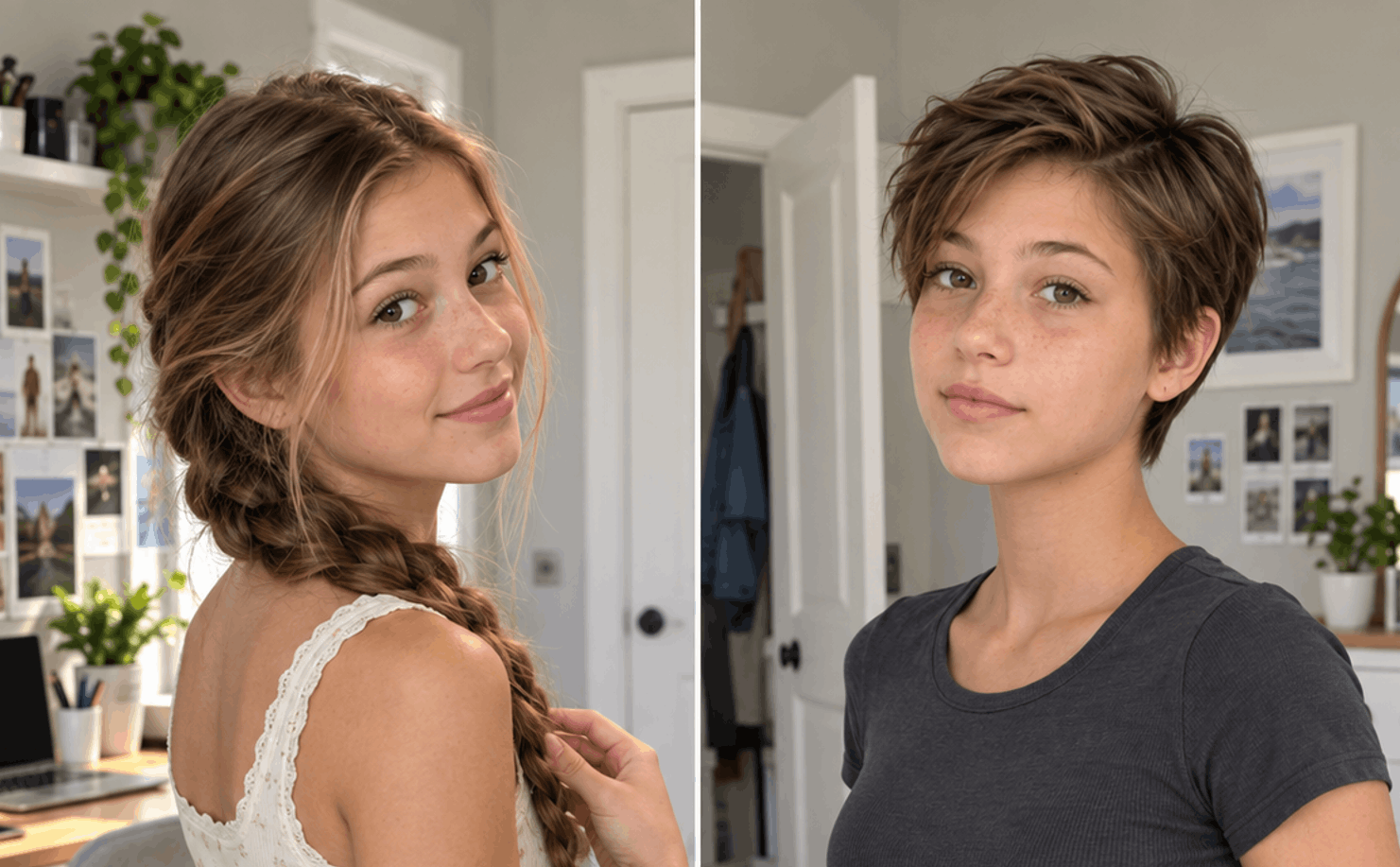
My Daughter Came Home With a Pixie Cut After Spending the Day With Her Grandmother
My 13-year-old daughter came home with a pixie haircut after spending the afternoon with my mother-in-law – and when I discovered what had really happened, I broke down crying.
Maya, my daughter, had always been known for her hair. It was thick, dark auburn, and reached almost to the middle of her thighs. She was incredibly proud of it, and even the slightest suggestion of cutting it would make her defensive.
Every Saturday evening, she would sit on a little stool between my knees while I carefully brushed it. Whenever I joked about getting it trimmed, she would immediately protest.
“Absolutely not, Mom. I want to be buried with this hair.”
“Mommy, I’m never cutting it.”
So when my mother-in-law, Carol, asked if she could take Maya into town for some shopping and frozen yogurt, I didn’t think anything of it. Carol and Maya had always been extremely close.
They left shortly after noon.
When Maya came back around 5:20 that afternoon, though, I immediately knew something was wrong.
“Hey, sweetheart! Did you have a good time with Grandma?” I called from the dining room.
She didn’t respond.
Instead, she hurried toward the staircase, wearing a huge sweatshirt pulled tightly around her face.
It was nearly 90 degrees outside.
“Maya, why are you dressed like that? You’re going to be sweating.”
“I’m freezing,” she mumbled.
She wouldn’t look at me.
I knew that voice.
My daughter was hiding something.
I followed her upstairs and found her sitting rigidly on the edge of her bed.
“Maya, honey, look at me. What happened?”
“Nothing.”
But then I noticed something.
Tiny strands of dark auburn hair were stuck to the collar of her sweatshirt.
My stomach dropped.
“Maya… take the hood down.”
Her eyes immediately became watery.
“Mom, please don’t.”
“Whatever happened, you can tell me.”
For several seconds, she just stared at the floor.
Then, with shaking fingers, she slowly pulled the hood away.
I froze.
The hair my daughter had spent nearly a decade growing was gone.
Not shortened.
Not cut to her shoulders.
Gone.
She was wearing a pixie cut.
“Oh, Maya…” I whispered. “Who did this to you?”
“Mom, please,” she said through tears. “Ask Grandma. I can’t tell you what happened.”
I didn’t need to hear anything else.
About fifteen minutes later, I was standing outside Carol’s house, pounding on the front door.
When she opened it, I barely gave her time to speak.
“What the hell did you do to my daughter?”
Carol stared at me silently.
But there was something strange about her expression.
She didn’t look defensive.
She didn’t look angry.
She looked completely heartbroken.
After a long moment, she stepped away from the doorway.
“You think I did this to Maya,” she said quietly.
“I didn’t.”
She swallowed hard.
“But when you find out why her hair had to be cut, I’m afraid you’re going to fall apart.”
What Carol Had Seen in the Frozen Yogurt Shop
I stepped inside.
Carol’s house always smelled like the same vanilla candle she’d burned for thirty years. That night I couldn’t even register it. I was standing in her kitchen with my arms crossed, jaw tight, watching her fill two glasses of water she knew neither of us would drink.
“Sit down,” she said.
I didn’t sit.
“Just tell me.”
She set the glasses on the counter and turned around. Her eyes were red. Carol is not a woman who cries easily. She raised three sons, buried a husband, and once drove herself to the ER with a broken wrist because she didn’t want to bother anyone. Seeing her look like that put something cold at the back of my neck.
“We were at the yogurt place on Clement,” she started. “The one with the little toppings bar Maya likes. We’d been there maybe twenty minutes.”
I nodded.
“There was a girl at the table next to us. Thirteen, fourteen maybe. She had a knit cap on, even though it was hot. Maya kept looking at her.”
Carol paused.
“The girl’s mother got up to refill her cup, and when she reached across the table, the cap shifted. Maya saw.”
“Saw what?”
“The girl had almost no hair, honey. Just patches. She was going through chemo.”
I put my hand on the back of the kitchen chair.
“Maya watched that girl for a long time. I didn’t say anything. I didn’t want to make it weird.” Carol pressed her lips together. “Then Maya leaned over to me and asked if I knew about Locks of Love.”
I knew what it was. I’d heard of it. Hair donation for kids with medical hair loss. I’d just never thought about it in connection with Maya’s hair because Maya would sooner have shaved her head than let anyone near it with scissors.
“She said she’d known about it for two years,” Carol said. “She’d been thinking about it for two years. But she was scared of what you’d think. She said – ” Carol stopped. Cleared her throat. “She said she didn’t want you to be sad.”
My hand was still on the back of that chair.
“So she asked me to take her,” Carol said. “She made me promise not to tell you ahead of time because she was afraid you’d talk her out of it. She wanted to just do it. She said if she went home and thought about it she’d never go through with it.”
I didn’t say anything for a long time.
The Part She’d Been Carrying Alone
Two years.
My daughter had been carrying this around for two years, watching that idea sit in the back of her mind, not saying anything. Not because she didn’t want to do it. Because she was protecting me.
She was thirteen years old and she was managing my feelings before she’d even made her own decision.
I thought about every Saturday evening on that little stool. The way she’d protest whenever I mentioned a trim. I want to be buried with this hair. She’d been saying that to keep herself from changing her mind. A thirteen-year-old holding the door closed against her own generosity because she thought it would hurt me.
Carol was watching me work through it.
“The stylist was wonderful,” she said. “She explained everything. The minimum length for donation is ten inches. Maya had enough to donate and still have some left. The pixie was just what remained.”
“Was she okay? During?”
“She cried a little when the first cut happened. Then she stopped.” Carol almost smiled. “Then she started coaching the stylist. ‘Make sure you get enough, I want it to count.'”
That was Maya. That was exactly Maya.
“She was so quiet on the way home,” Carol said. “I think she was already worried about your reaction. I told her you were going to be proud of her. She said, ‘What if she’s just sad about the hair?'”
I pressed my fingers to my mouth.
“I should have called you,” Carol said. “I know that. I should have called you from the parking lot and let you weigh in. But she begged me not to, and I – ” She shook her head. “She looked so certain. I didn’t want to be the one who stopped her.”
I wasn’t angry at Carol. I couldn’t be. Not really.
I drove home.
What I Found at the Top of the Stairs
Maya was still in her room.
The door was open a crack and her light was on. I pushed it open slowly. She was sitting at her desk pretending to do homework, her shoulders hunched up near her ears, not moving the pencil.
“Hey,” I said.
She turned around.
Without the hood, in the lamp light, I got my first real look at her. The pixie cut was actually beautiful. It showed the shape of her face in a way all that hair never had, the line of her jaw, her ears, the length of her neck. She looked older. She looked, somehow, more like herself.
Her eyes were still puffy.
“Grandma told you,” she said.
“She did.”
Maya turned the pencil over in her fingers. “Are you mad?”
I sat down on the edge of her bed. Same spot she’d been sitting when I’d first come upstairs, two hours ago, a completely different version of this conversation.
“No, baby. I’m not mad.”
“Are you sad about the hair?”
I had to be honest with her. She deserved that.
“A little,” I said. “Yeah. A little bit sad. But not the way you think.”
She waited.
“I’m sad that you were scared to tell me. I’m sad that you thought you had to protect me from something you wanted to do. That’s the part that gets me.”
She looked at the pencil.
“I didn’t want you to cry,” she said. “You always get sad when things change.”
She wasn’t wrong about that. I’m the person who cried when we got rid of her booster seat. I cried when she stopped calling me Mommy and started calling me Mom. She’d been watching me grieve small changes her whole life and she’d decided, at eleven, to start editing herself around it.
“Maya. Look at me.”
She looked up.
“You did something remarkable today. You saw someone hurting and you decided to do something about it. You’ve been thinking about it for two years and you finally did it. That is – ” My throat got tight. “That is not something I’m sad about. Not even a little.”
Her chin went.
Then she was crying, and I was crying, and she crossed the room and put her arms around me and she was so much taller than she used to be, her chin on my shoulder instead of her forehead on my chest.
We stayed like that for a while.
The Letter That Came Six Weeks Later
I’d mostly stopped thinking about the hair. You get used to a new thing faster than you expect.
Maya had started to like the pixie. She’d stopped wearing hoods. She’d started tucking a small earring into her left ear, a little gold leaf she’d bought with her own money, and she had opinions now about whether her neck was cold, which was apparently a whole new sensory experience she found annoying but interesting.
Then the letter came.
It was addressed to Maya, from the organization that processes the donations. A form letter, I figured. A thank-you, a receipt, a tax document for the donation record.
Maya opened it at the kitchen table.
She read it once. Then she read it again, slower.
“Mom.”
I came over.
It wasn’t a form letter.
A family had written in. They didn’t give identifying details, just a first name. A girl named Becca, twelve years old, had received a wig made in part from Maya’s donation. Becca’s mother had written three paragraphs in handwriting that slanted hard to the right, the kind of handwriting that happens when your hand is moving faster than your thoughts.
She wrote that Becca had refused to go back to school after her diagnosis. She’d been doing remote learning for four months. She wouldn’t leave the house without a hat.
The wig changed that.
Becca wore it to school for the first time on a Thursday in March. She’d come home and told her mother it was the first day she’d felt normal in almost a year.
Becca’s mother didn’t know Maya’s name. She just knew the donor was a girl around Becca’s age with dark auburn hair. She’d written the letter to the organization hoping it might reach whoever that girl was.
It did.
Maya sat at the kitchen table for a long time after she finished reading. She wasn’t crying. She was doing something quieter than crying.
I put the letter down on the table and didn’t say anything.
After a while, Maya picked up her pencil, turned the letter over, and wrote something on the back.
“Can we send a letter back?” she asked.
“I’ll find out,” I said.
She nodded and kept writing.
I watched my daughter, with her gold leaf earring and her short hair and her thirteen-year-old handwriting, write a letter to a girl she’d never met.
And I thought about all the things you don’t know your kid is carrying until the hood comes down.
—
If this one got you, pass it along to someone who needs it today.