I Heard My Husband Whisper a Secret Over My Mother’s Coffin – Then I Dug Up Her Backyard
My husband, Daniel, and my mother, Evelyn, could barely tolerate each other from the day they met.
For twenty-six years, every family gathering at Mom’s house in Fairview ended with clipped answers, uncomfortable smiles, and one of them inventing an excuse to leave before dessert. Mom never referred to Daniel as her son, and he once admitted that he would rather work through Thanksgiving than spend another afternoon under her roof.
I never understood the reason for their hostility.
Whenever I questioned them, they both gave me the same vague response:
“We simply don’t get along. We come from different worlds.”
I assumed Mom looked down on Daniel because she was a wealthy entrepreneur and he had grown up with very little. Their different backgrounds had never bothered me, though.
One Wednesday evening, following an especially bitter argument, I overheard Mom snap:
“You know perfectly well what you did.”
Daniel immediately fell silent.
Neither of them would explain what she meant, and eventually, I stopped asking.
Then Mom died at the age of seventy-nine.
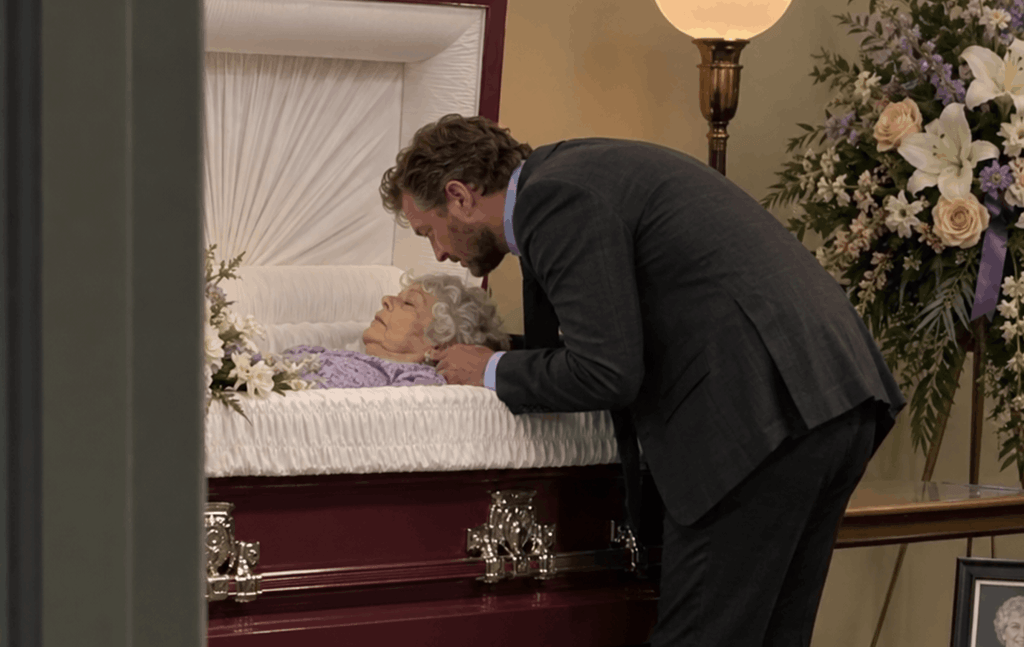
During the funeral reception on Saturday, I noticed that Daniel had disappeared from the gathering room. While searching for him, I found him standing beside Mom’s open coffin.
I stopped in the hallway when I heard him whisper:
“I protected our secret, Evelyn.”
He gently ran his fingers along the coffin and added:
“No one ever discovered the truth.”
My stomach tightened.
Then he murmured:
“It will remain buried beneath the red maple behind your house.”
I quietly stepped away before he could see me.
The maple stood in the backyard of Mom’s Fairview home. She had planted it twenty-six years earlier and cared for it as though it were another member of the family.
She never allowed gardeners to work near it. She refused to cut it down even after its roots damaged the stone path. Once, she became furious when my daughter scraped at the soil beneath it with a plastic spade.
Until that moment, I had believed Mom was simply attached to the tree.
At nearly eleven that night, after the final guests had left, I returned to her vacant house.
The maple’s branches stretched above me in the dim porch light.
I retrieved a shovel from the shed and began digging.
After roughly twenty-three minutes, I had uncovered nothing except tangled roots and damp soil. I was ready to stop when the shovel struck a hard object.
It sounded like metal.
About twenty-one inches below the surface, I found a rust-covered box wrapped tightly in multiple plastic bags.
My heart began pounding.
With trembling hands, I carried the container onto the back porch.
The moment I opened it, a chill swept through me.
I grabbed my phone and called the police.
What the Box Actually Held
The box was a military-style ammunition can. Olive green under the rust. The kind you can still find at Army surplus stores for twelve dollars.
Inside, sealed in a second layer of zip-lock bags, were documents. A thick stack of them. Photographs. A handwritten letter. And a smaller envelope, rubber-banded shut, with my name written on the front in Mom’s handwriting.
The photographs were the first thing I could actually process. The documents were dense, typed, full of legal language I couldn’t parse standing on a back porch in the dark at eleven-fifteen on the night of my mother’s funeral. But photographs are immediate.
The top one showed Daniel. Young. Maybe twenty-three, twenty-four. Before I knew him.
He was standing beside a man I didn’t recognize, outside a building I didn’t recognize. Both of them were smiling. Nothing remarkable about the image except for the date stamp in the bottom corner: April 1997.
I met Daniel in 1999.
The next photograph showed the same unknown man, this time alone, standing in front of what looked like a construction site. Hard hat. Safety vest. Big smile, the kind people wear when something good is happening.
The third photograph was different. Same man. Same site. But he wasn’t smiling. He was on a stretcher. The site behind him had partially collapsed. Yellow caution tape. Three or four workers in the background, frozen, arms out.
I sat down on the porch step.
The Name on the Documents
The documents were a civil lawsuit. Filed in March 1998. The plaintiff was a man named Gary Pruitt. The defendant was a construction subcontracting company called Meridian Site Works.
Daniel had worked for Meridian Site Works from 1995 to 1998. He’d told me that much, early in our relationship. Entry-level labor, he’d said. Nothing interesting. He’d gotten out before the company folded.
Gary Pruitt, according to the lawsuit, had suffered a spinal injury in a worksite collapse in April 1997. He was twenty-nine years old. The suit alleged that Meridian Site Works had ignored three separate safety violations flagged by inspectors in the eight weeks prior to the collapse. It alleged that a site supervisor had signed off on falsified inspection reports.
The suit was settled out of court in October 1998 for an amount that was listed as confidential.
There was a handwritten note clipped to the back page of the settlement agreement. The handwriting was Mom’s. She’d written two lines: D. was the supervisor. He signed the reports. Gary never walked again.
I put the documents down on the porch boards and just sat there.
The maple was twenty feet away. Dark. Quiet. The roots had been pushing up through the stone path for years and Mom had never once let anyone touch them.
The Letter She Left
I opened the envelope with my name on it last.
It was four pages, front and back, written in Mom’s tight, slanted handwriting. She’d dated it six months earlier, January of this year, when she already knew she was sick.
I’m going to give you the important parts exactly as she wrote them.
I found out about Daniel and Gary Pruitt six months before your wedding. A woman named Cheryl Hatch, who had worked in Meridian’s office, contacted me. She had kept copies of the original inspection reports – the real ones, before Daniel altered them. She wanted someone to know. She wasn’t looking for money. She just wanted someone to know.
I confronted Daniel privately. I told him I would go to Gary Pruitt’s attorney with what I had. Daniel told me Gary had already settled. He said reopening it would destroy your life, not just his. He said you were in love with him and that going forward would hurt you more than it would hurt him. He begged me. And then – this is the part I am most ashamed of – he told me that Gary Pruitt had accepted a settlement and signed a release and had explicitly said he wanted it over. Daniel had spoken to Gary himself. Gary had said: let it go.
I called Gary Pruitt. He confirmed it. He said he was tired. He said the money had let him buy a house and that his wife was pregnant and he did not want to spend another year in a courtroom. He said the only thing he wanted was for the man who signed those reports to know, for the rest of his life, exactly what he had done.
So I made Daniel a different kind of deal. I kept the documents. I kept Cheryl’s originals. And I told Daniel that as long as he was your husband, he would carry what he did. He would never forget. He would never get comfortable. He would never have a single easy afternoon in my house. That was the price. That was all I could give Gary Pruitt that Gary Pruitt hadn’t already given away himself.
I am not proud of this. I do not know if I was right. I kept it from you because you were happy, and because Gary had chosen silence, and because I was afraid of what the truth would do to the life you had built.
But I could not take it to my grave without leaving it somewhere. So I left it here.
The box was Daniel’s idea, actually. He asked me, years ago, to destroy the documents. I told him I would keep them instead. He hated that. Good.
I love you. I’m sorry.
Mom
What Daniel Said When I Showed Him
I drove home. It was almost one in the morning.
Daniel was awake. He was sitting in the kitchen with a glass of water, still in his funeral clothes, jacket off, tie loosened. He looked up when I came in.
I set the box on the kitchen table without saying anything.
He looked at it for a long time.
“You went to the tree,” he said.
“Yes.”
He nodded slowly. His hands were flat on the table. He didn’t reach for the box.
“I loved her, you know,” he said. “Your mother. I know that sounds insane. But she was the only person who ever made me keep accounting for it.”
I didn’t say anything.
“I’ve called Gary Pruitt,” he said. “Three times. He never called back. I don’t blame him.”
“He never walked again, Daniel.”
“I know.”
He said it the way a person says something they’ve said to themselves ten thousand times. Not defensive. Not broken. Just worn flat by repetition.
“What do you need from me?” he asked.
I didn’t know the answer to that yet. I’m still not sure I do.
What I Did With the Box
I called the police that night because I didn’t know what else to do. I wasn’t sure if there was a crime still actionable, if the statute of limitations had long since closed, if the documents meant anything legally after a settled case and a signed release.
The officer who came out was patient. He looked at the documents, wrote down names and dates, told me he’d pass it to someone who handled civil matters. He was honest with me: twenty-six years after a settled lawsuit, with a plaintiff who had accepted terms and signed a release, there probably wasn’t a criminal case. Probably.
He took copies of everything anyway.
I haven’t decided yet what to do about Daniel. We’ve been married for twenty-four years. We have two kids. He’s been, by every measure I had access to, a decent husband and a decent father. He’s also a man who falsified safety documents, watched a twenty-nine-year-old get put on a stretcher, and spent the next quarter century keeping a secret from me that my mother had to carry alone.
Both of those things are true at the same time. I don’t know what to do with that.
Gary Pruitt, I found out, lives in a town called Redfield, about ninety minutes from here. He’s fifty-six now. He and his wife have three kids. He coaches his youngest son’s wheelchair basketball team, according to a local newspaper article from 2021 that I found online at two in the morning, sitting on the kitchen floor with my back against the cabinet.
I don’t know if I’ll contact him. I don’t know if that would help him or just drag him back somewhere he decided to leave behind.
The Maple Is Still Standing
I went back to Mom’s house the next afternoon and filled in the hole.
The soil was still loose and dark. I packed it down as best I could, replaced the roots I’d disturbed, and stood there for a while with dirt on my hands and my knees.
The tree is enormous now. Twenty-six years of growing. The roots have completely destroyed the stone path. There’s no fixing that short of taking the whole thing out.
Mom never would have let anyone touch it. Now I understand why.
I don’t know if she was right to make the deal she made. I don’t know if keeping Daniel’s guilt alive for two and a half decades was justice or just punishment or just the only tool she had. I’m not sure those are different things.
What I know is that she spent twenty-six years sitting at the same table as a man she held a secret over, watching him squirm, watching him earn the discomfort she gave him, and she never once told me. She protected me. She protected Gary Pruitt’s peace. She protected the marriage I was living inside.
She was seventy-nine years old and she still found a way to make sure someone knew.
The box is in my closet now. I’m not ready to do anything with it yet.
But I’m not burying it again.
—
If this one stayed with you, share it with someone you trust. Or tell me: what would you have done with that box?
