My Daughter Made the Woman Next to Me Sprint Up the Aisle at 30,000 Feet
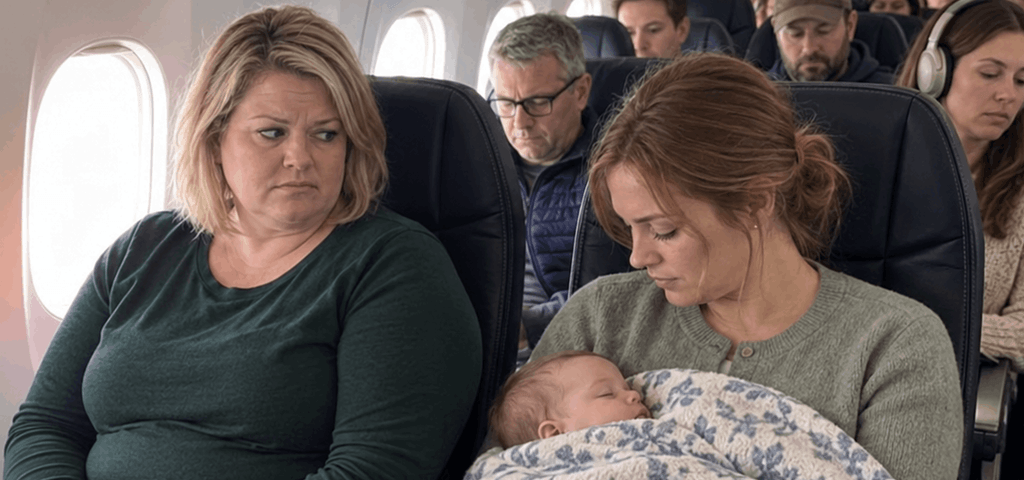
While I was nursing my six-month-old son aboard a flight to Portland, the passenger beside me shouted, “That’s disgusting! Go hide in the restroom!” But what my older daughter did next left the entire cabin staring.
Five weeks earlier, I had buried my husband. I was still overwhelmed by grief when my mother invited the children and me to stay with her in Maplewood for a while.
Our Thursday afternoon flight was completely full. Because we couldn’t find three seats together, my nine-year-old daughter, Sophie, had to sit in the row behind me.
Holding my infant son, I settled into my assigned seat beside a middle-aged woman.
She appeared irritated before the plane had even left the gate.
“If that baby starts WAILING, I’m not putting up with it for the whole flight,” she warned. “You’ll need to control him.”
I tried not to react. My son was peacefully asleep, and I didn’t want to create an argument before takeoff.
About two hours later, however, he woke up crying.
I rocked him gently and offered him his pacifier, but neither helped. I quickly realized that he was hungry.
After arranging a nursing cover for privacy, I began feeding him.
The woman released an exaggerated groan.
“Are you SERIOUS?” she exclaimed. “First, I have to hear your baby crying, and now you expect me to sit here while you do THAT? You should be embarrassed!”
Several passengers turned toward us.
Trying to remain calm, I gave her a small, apologetic smile.
“I’m sorry you’re uncomfortable, but my baby needs to eat.”
She shook her head and glared at me.
“Women with infants should stay home,” she snapped. “What sort of mother can’t even keep her own child quiet?”
My face burned as more people began watching.
I explained that it was a five-and-a-half-hour flight and that I couldn’t simply refuse to feed my son.
“Then take him into the bathroom and LOCK THE DOOR!” she shouted. “Why should I be forced to watch something so shameful?”
Before I could respond, Sophie stepped into the aisle.
“Mom, you can have my seat,” she said sweetly. “I’ll sit here so this woman won’t have to feel uncomfortable anymore.”
We exchanged places.
From the row behind them, I watched Sophie pull out her tablet. She tapped the screen several times before turning it toward the woman.
The passenger’s face suddenly went pale.
She screamed, sprang out of her seat, and rushed toward the front of the cabin as everyone nearby turned to see what Sophie had shown her.
What Was Actually on That Tablet
The cabin had gone quiet the way cabins go quiet when something is genuinely wrong. Not the usual background hush of people politely ignoring each other. Real silence. The kind where you can hear the hum of the engines differently.
I had a clear sightline from my new seat. Sophie was sitting with her back straight, tablet face-up in her lap, expression completely neutral. The woman was pressed against the aisle side of her seat, pointing at the tablet, voice high and strange.
A flight attendant, a younger woman with a dark bun and the look of someone who had seen a lot of things, came down the aisle fast. She leaned in to look at the screen. Her expression didn’t change exactly, but something shifted in it.
She asked Sophie a question I couldn’t hear. Sophie answered. The attendant nodded, straightened up, and looked at the woman.
“Ma’am, I’m going to need you to come with me.”
The woman went. She didn’t argue. She grabbed her purse and walked toward the front of the plane and didn’t look back at Sophie once.
I was still holding Caleb, who had finished eating and was drowsy against my chest. I leaned into the aisle. “Sophie. What did you show her?”
Sophie turned the tablet around so I could see.
It was a screenshot. The woman’s own Facebook profile, public settings, full name visible at the top. Below that, a post from three days ago. A photo of herself at what looked like an airport gate, captioned: Praying I don’t get stuck next to any screaming children or nursing mothers on my flight Thursday. Some people have NO self-awareness. Keep that at home.
Forty-seven comments. Most of them agreeing with her. Her full name on every one.
Sophie had found it in about four minutes of searching, apparently, after the shouting started. She’d heard the whole thing from the row behind us. She’d been waiting.
The Part Nobody Saw Coming
Here’s what I didn’t know until the flight attendant came back to check on me, about twenty minutes after the woman had been relocated to a jump seat near the galley.
The woman wasn’t just a random unpleasant stranger.
She was a parenting blogger.
I don’t mean a small one. The attendant mentioned it quietly, the way you mention something that explains a lot without quite excusing anything. Apparently one of the other passengers had recognized her and said something. Her whole brand, the attendant said, was family-friendly travel tips. Traveling gracefully with children. Patience and kindness in close quarters.
She had 200,000 followers on Instagram.
She had a highlight reel called Flying With Grace.
Sophie looked up at me when the attendant walked away. “Is that funny?” she asked. “I can’t tell if that’s funny.”
I told her I genuinely didn’t know.
Caleb made a sound like a small question mark and fell asleep.
The Five Weeks Before That Flight
I need to back up.
My husband, Derek, died on a Tuesday in late October. Aneurysm. He was thirty-eight. He was in the kitchen making coffee and then he wasn’t anywhere anymore.
I’m not going to describe the weeks that followed in any way that makes them sound manageable, because they weren’t. There were forms. There were phone calls. There was a funeral where I stood in the cold and held Caleb against my coat and watched Sophie hold my hand instead of the other way around, which was wrong, all of it wrong.
My mother lives in Maplewood. She’s not a dramatic woman. She called me once, said “come stay for a while,” and then waited. She didn’t push. Didn’t call back every day. Just waited.
Three weeks after the funeral I called her and said we’d come Thursday.
I booked the tickets at midnight on a Wednesday with Caleb in my lap, the house too quiet in the way that houses get when someone who used to be loud in them is gone. Derek was not a loud man. But his absence had a sound.
Sophie was the one who packed her own bag. She packed Caleb’s bag too, because I kept standing in front of his dresser and forgetting what I was doing there.
On the way to the airport she held my hand in the back of the car. She’s nine. She has Derek’s jaw and his way of going still when she’s thinking hard about something.
I didn’t know, getting on that plane, that she’d been thinking hard about something for a while.
What Nine Looks Like When It Has to Grow Up Fast
Sophie found the Facebook post through a combination of things I still don’t fully understand. She’d heard the woman’s voice carrying over the seat back. She’d caught the woman’s name on her boarding pass when it had briefly been visible in the seat pocket, apparently. She’d searched the name plus a few keywords on her tablet with the airplane wifi I’d bought for the flight and paid too much for.
Four minutes.
She didn’t say anything to me while she was doing it. She just waited until she had something.
That’s Derek, that patience. That’s exactly Derek.
She didn’t show the woman the post to be cruel, or at least that’s not the whole of it. She told me later, at my mother’s kitchen table, that she’d wanted the woman to understand that she wasn’t invisible. That what she’d said to me wasn’t private. That it was already out in the world attached to her name.
“I didn’t yell,” Sophie said. “I just showed her.”
My mother, who was standing at the stove, didn’t turn around. But her shoulders moved.
“Good,” she said.
What Happened When We Landed
The woman did not speak to us again during the flight. She stayed near the front. A different flight attendant, older, with gray at her temples, came by once to ask if I needed anything and spent a little longer than necessary making sure Caleb was settled.
When we landed in Portland and the seatbelt sign went off, there was that usual crush of people standing up too early and reaching for overhead bins. The man across the aisle from me, who had been silent the entire flight, leaned over while he was pulling down his bag.
“Good kid you got there,” he said. He meant Sophie.
I said thank you.
He nodded and moved on. That was it. No speech, no moment, just a man with a carry-on and a direct flight home saying a true thing and leaving.
Sophie was already in the aisle, Caleb’s diaper bag over one shoulder, her tablet tucked under her arm. She looked back at me with an expression I recognized and couldn’t name, something between exhausted and fine.
“Grandma’s going to have food ready,” she said.
She was right. My mother had a pot of something on the stove and the back door unlocked and the guest room made up with the good sheets. We drove there from the airport in the early evening, Caleb asleep in his car seat, Sophie with her forehead against the window watching Oregon go by.
The woman’s Instagram, I found out later from a friend who sent me a screenshot, had gone quiet for about two weeks after that flight. When she came back she posted a long caption about grace and growth and learning from unexpected moments.
She didn’t mention a nine-year-old.
She didn’t mention me.
She got 14,000 likes.
Sophie, when I showed her, read the whole thing without expression. Then she put the phone down and asked if we could take Grandma’s dog for a walk.
We did. It was cold and the leaves were mostly down and Caleb was in the carrier against my chest, awake and watching the trees like they were the most interesting things he’d ever seen. Sophie walked ahead with the dog, an old beagle named Rusty who moved at his own pace and stopped to smell everything.
She didn’t say anything about the post. She didn’t need to.
—
If this story sat with you, pass it along to someone who’d get it.
