The Cashier Froze When She Saw My Mother’s Face – Then Locked Her Register
At eighty-four, my mother still preferred doing her own grocery shopping.
On Sunday afternoon, the Fresh Valley Market in Brookdale was packed with customers.
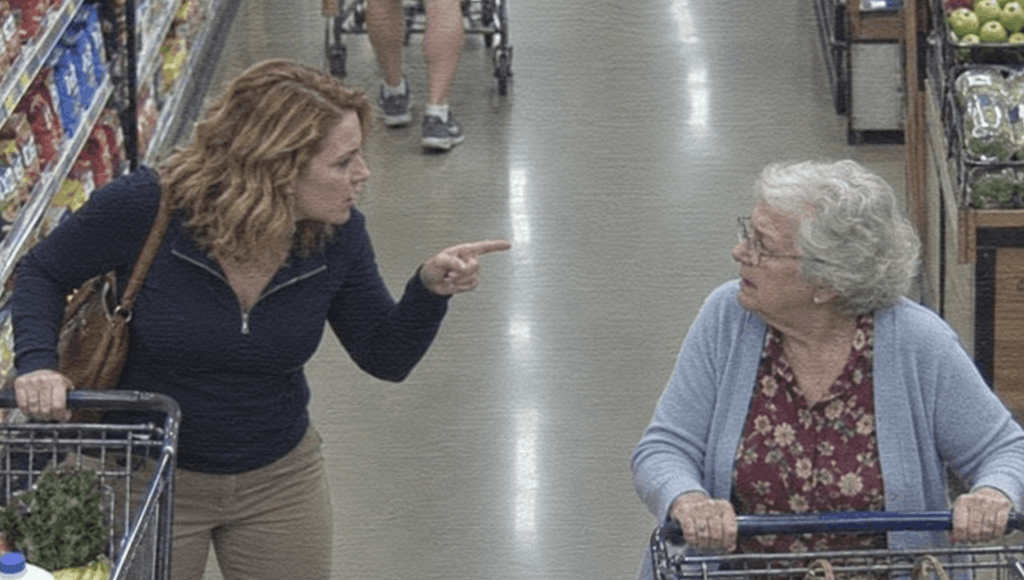
Mom had placed only seven items in her basket, but when we reached the register, she had difficulty finding her purse inside her shopping bag.
The woman waiting behind us released an exaggerated sigh.
“Oh, for goodness’ sake!”
Mom’s hands trembled slightly as she apologized.
Instead of showing patience, the woman pushed her overflowing cart closer to us.
“If you’re too old to handle a simple shopping trip, perhaps you should stay home,” she snapped.
Several customers turned to look.
“Excuse me?” I said.
The woman folded her arms and rolled her eyes.
“I’m only saying what everybody else here is thinking.”
After another moment, Mom found her purse, took out her wallet, and passed her bank card to the cashier.
The impatient woman laughed under her breath.
“This is ridiculous. Are we all supposed to stand here forever?”
The cashier, a woman who appeared to be about fifty-two, looked directly at my mother’s face and suddenly froze.
“What is your name?” she asked softly.
My mother seemed confused.
“Eleanor.”
The cashier stared at her for another second. Then she reached beneath the counter, locked her register with a sharp click, and switched off the conveyor belt.
“Nobody leaves this checkout line,” she announced quietly.
The rude shopper scoffed.
“You can’t be serious!”
The cashier ignored her and spoke into the store phone in a hushed voice.
Less than three minutes later, the manager hurried over carrying a dusty cardboard box that looked as though it had been sitting in the back office for decades.
What Was Inside That Box
The manager was a heavyset man named Doug, maybe forty, with a key ring on his belt that jangled when he walked fast. He was walking fast now.
He set the box on the end of the conveyor belt. Brown corrugated cardboard, the flaps folded in on each other. A strip of old tape along one side had given up entirely and curled away like dead skin.
The cashier – her name tag said Brenda – put one hand on top of it.
“I’ve been keeping this since I transferred from the Millhaven location,” she said. “Twelve years. I kept thinking I’d find the right person to give it to.”
My mother still had her bank card in her hand.
Brenda looked at her. “Eleanor. Did you used to work at a school? Millhaven Elementary? Back in the late eighties, early nineties?”
Mom’s face changed. I’ve known that face for fifty-one years and I can’t always read it, but something moved behind her eyes.
“I taught there for fourteen years,” she said.
Brenda nodded once, slowly. “Fifth grade.”
“Yes.”
“1991.”
Mom went very still.
The woman behind us had stopped making noise.
The Girl Nobody Talked About
Brenda opened the box.
Inside: a folded piece of paper on top of a child’s composition notebook, the black-and-white marbled kind, and underneath that a photograph face-down and a small enamel pin shaped like a sparrow.
Brenda picked up the folded paper first and held it out to my mother. Her hand was not entirely steady.
“My daughter wrote that when she was ten,” she said. “Her name was Casey.”
Mom unfolded it. I read it over her shoulder.
Dear Mrs. Eleanor, you are the only teacher who ever asked me if I was okay at home. You are the only one who noticed. I don’t know how to say thank you so I am writing it down. – Casey Pruitt, age 10.
That was the whole letter. Pencil on wide-ruled paper, the handwriting of a kid who was trying hard.
My mother pressed the letter against her chest.
Brenda pulled in a breath. “Casey had a rough time at home when she was small. Her dad was in and out. I was working two jobs and I wasn’t – I wasn’t always paying attention the way I should have.” She stopped. Started again. “Her teacher that year was the one person who kept checking on her. Kept a chair next to her desk. Sent notes home. Called me once at eleven at night because Casey had come to school with a bruise she didn’t believe was from a bike.”
Mom said, “I remember a Casey.”
“She’s thirty-three now,” Brenda said. “She’s a social worker in Portland. Has two kids. She’s fine. She’s really fine.” She put a hand over her mouth for a second. “She told me about you when she was in high school. She said you were the reason she knew adults could be safe. I’ve been carrying this box around for twelve years thinking I’d never find you.”
The Woman Behind Us
Nobody was moving.
The woman with the overflowing cart had gone completely quiet. I don’t know her name. I didn’t look at her directly after a certain point. But I was aware of her the way you’re aware of a television someone’s turned the sound off on.
A man in line behind her had put his hands in his pockets and was looking at the floor.
Doug the manager was pretending to examine the side of the cardboard box.
My mother is not a crier. She raised three kids, buried a husband, survived a cancer scare at seventy-seven, and I have seen her cry maybe four times in my life. She didn’t cry now. She held the letter and looked at Brenda and said, “How is she really?”
“Really?” Brenda almost smiled. “She’s bossy. She argues with her husband about the thermostat. She coaches her daughter’s soccer team even though she doesn’t know anything about soccer.” A real smile then, lopsided. “She’s stubborn as hell. I wonder where she got that.”
Mom laughed. It came out surprised, like she hadn’t expected it.
Brenda passed her the composition notebook. “Casey kept a journal that year. She said I could give you this if I ever found you. She wanted you to know what that year looked like from her side.”
Mom tucked the notebook under her arm like it was something breakable.
Then Brenda picked up the small enamel sparrow pin and held it out on her palm.
“Casey picked this out herself,” she said. “She said sparrows were your thing. That you had a poster of one above your desk with a quote on it.”
My mother touched the pin with one finger. “Matthew 10:29,” she said quietly. “Are not two sparrows sold for a penny, yet not one of them falls to the ground outside your Father’s care.”
She’d had that poster for thirty years before she retired. I’d seen it a hundred times and never asked about it.
What Brenda Did Next
Brenda unlocked the register.
She rang up my mother’s seven items without saying anything else. Bread, soup, two cans of tomatoes, a bunch of bananas, a small thing of yogurt, and a birthday card for my nephew.
She bagged them herself, carefully, the way people used to.
Total came to $31.14.
My mother paid. Put her card back in her wallet. Picked up the bag.
Then Brenda reached across the counter and held my mother’s hand for about four seconds. No words. Just that.
We stepped away from the register.
I don’t know what happened with the woman behind us. I heard Doug say something to her in a low voice as we walked toward the exit. I didn’t hear her response. I didn’t turn around.
The Parking Lot
It was cold out. Late February, the kind of Sunday where the light is already going at four in the afternoon and the parking lot looks gray and used up.
Mom held the box against her coat.
I unlocked the car and she got in and sat there with the box on her lap and the bag at her feet and she didn’t say anything for a while.
I started the engine to get the heat going.
“I didn’t know if I’d reached any of them,” she said finally. “You teach for that long and you pour everything in and you retire and you just – you don’t know.”
She opened the box again and looked at the letter. Casey’s pencil handwriting.
“I had forty-some students that year,” she said. “I remember Casey. Small girl. Very quiet. She used to come in early and water the plants on the windowsill before the other kids arrived. I let her because I think she needed somewhere to be.”
She folded the letter back up.
“I had no idea,” she said.
We sat there while the heat came up. A shopping cart rolled slowly across the empty space in front of us and bumped into a concrete barrier and stopped.
Mom put the sparrow pin in her coat pocket.
“Take me home,” she said. “I want to read this notebook.”
I pulled out of the space and headed for the exit. She held the box the whole way home, both hands, like it might shift if she loosened her grip.
She didn’t say anything else. Neither did I.
Some things you just drive through.
—
If this one hit you somewhere, pass it on to someone who needs it today.
